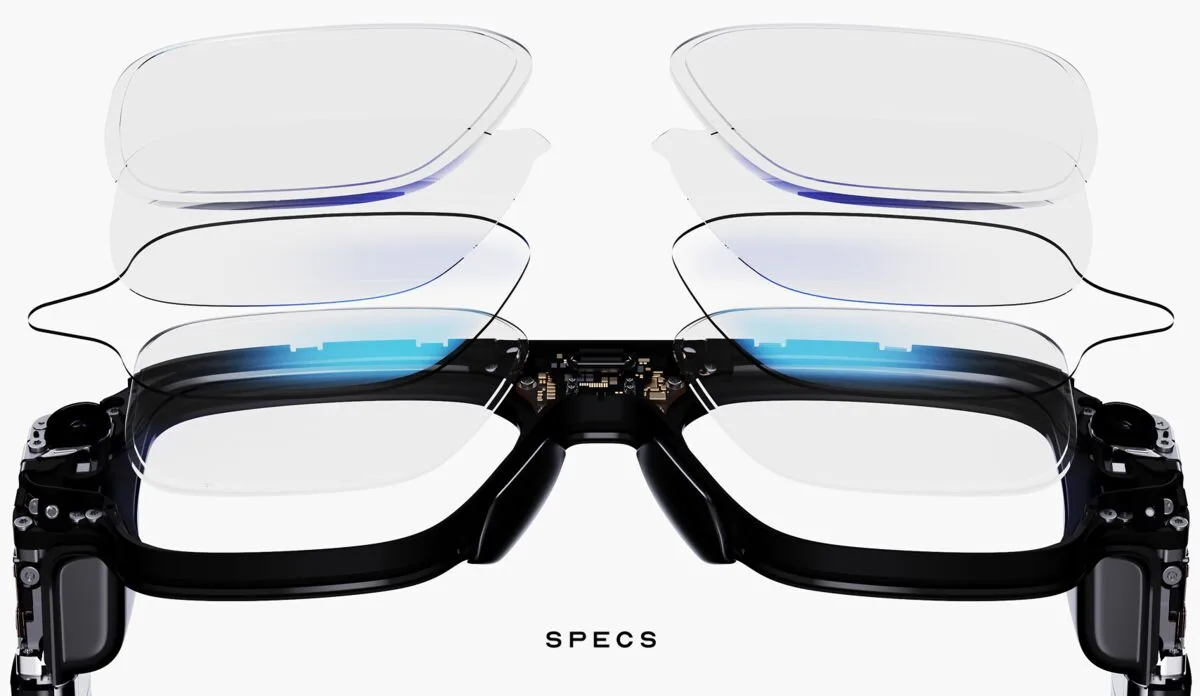
Google Glass launched in 2013 at $1,500 and was effectively dead as a consumer product within two years. Snap's new Specs cost $2,195 and are being positioned as "the computer of the future." That's an ambitious number, and an even more ambitious claim.
Snap CEO Evan Spiegel debuted the Specs on June 16th, describing them in a CNBC interview as the result of more than 12 years of development. The pitch is straightforward: people are tired of looking down at screens, and AR glasses can "bring computing into the world" and "make it more human." Spiegel wants the Specs to keep users more present, more connected to their surroundings, less buried in a phone.
It's a coherent vision. Whether the hardware can actually deliver it at scale is a different question entirely.
$2,195 puts the Specs firmly in enterprise or early-adopter territory. For context, that's more than a base model MacBook Air, more than Meta's Ray-Ban smart glasses by a factor of roughly four, and well above what most consumers will spend on a wearable. I've seen enough spec sheets to know that price points like this rarely signal mass-market confidence from the manufacturer; they signal that yields are low, components are expensive, or both.
Snap hasn't disclosed production volume targets, unit sales projections, or supply chain details. The company also hasn't released a full technical spec sheet publicly, so it's too early to say how the display resolution, field of view, or battery life compare to competing AR hardware like Meta's upcoming mixed reality devices or Apple's Vision Pro, which sits at the far higher end at $3,499.
What we do know, reported by Bloomberg, is that Spiegel called this a "leapfrog advancement." The real test is production volume and whether developers build for the platform.
The fashion problem is real and probably underappreciated in the coverage so far. The Verge noted something worth sitting with: while Spiegel was talking about freeing people from screens, the Specs' display outline was visible every time the light caught his lenses at the right angle. There's something sort of ironic about selling screen-free presence while wearing a device that advertises its own display to everyone around you.
Bold fashion has historically not translated to mainstream wearable success. The Verge's framing, "Can anyone look cool wearing Snap's $2,000 glasses?", is a sharper question than it sounds. Consumer hardware lives and dies on whether people will actually wear it in public, daily, without feeling self-conscious. Snap hasn't solved that. Nobody has.
From my time in hardware, the other quiet killer for wearables at this price is the software ecosystem. Without compelling applications that justify the form factor over just pulling out your phone, even well-built hardware stalls. Snap has a social media background, which gives it some leverage with developers, but it remains unclear whether Snapchat's core user base, which skews young and mobile-first, will pay $2,195 for a glasses-based experience.
Apple, according to a separate Bloomberg report, is planning its own smart glasses as part of a broader product push alongside camera-equipped AirPods and a foldable iPhone, with that hardware likely arriving in 2027. That timeline matters. Snap is effectively trying to establish platform footing before Apple enters the space with its distribution, its developer relationships, and its retail presence.
That's a narrow window. Snap has been working on this for over a decade, which is either a sign of deep commitment or a warning about how hard the problem actually is. Probably both.
Look, I'm not writing off the Specs. The hardware category is real, the underlying use case is legitimate, and Snap has more AR experience than most companies in the space. But a $2,195 price tag with no disclosed volume targets and a fashion challenge that the industry hasn't cracked in 13 years deserves more scrutiny than the launch-day coverage is giving it. The graveyard of smart glasses is well-populated. Snap needs to show this one is different.