Two New Datasets Want to Make Humanoid Robots Safer and More Capable. Here's What They Actually Do.
A pair of freshly released robotics datasets tackle opposite ends of the same problem: teaching humanoids what to do, and teaching them what not to do.
By
Think of it like driver's ed. You need two things: enough hours behind the wheel to get comfortable, and a clear understanding of what happens when you run a red light. Humanoid robots, it turns out, need something similar. Two new datasets released this month tackle exactly those two sides of the problem, and together they paint a pretty interesting picture of where embodied AI research is right now.
One is called Humanoid Everyday. The other is ROBOSHACKLES. Yes, really.
What is Humanoid Everyday, and why does it matter?
Most robot learning datasets are built around stationary robot arms. A fixed base, a controlled environment, a narrow set of tasks. That setup makes sense for research purposes, but it doesn't map well onto what people actually want humanoid robots to do in the real world, which involves moving around, picking things up, interacting with humans, and handling situations that weren't scripted in advance.
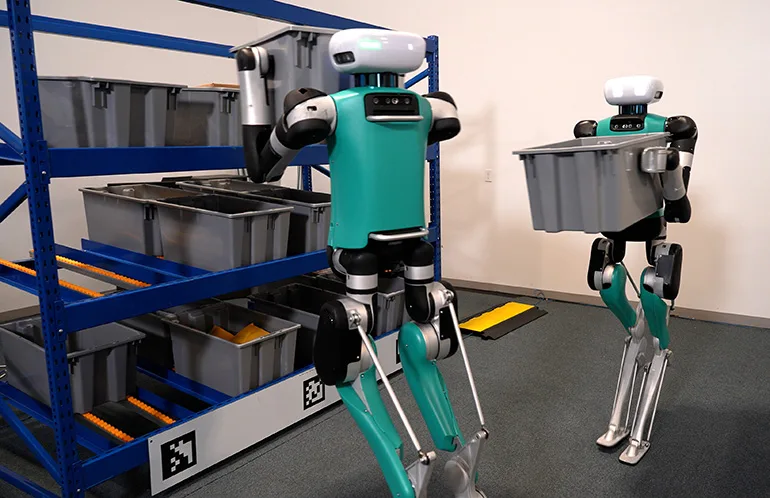
Humanoid Everyday, from a team of researchers whose paper just appeared on arXiv, tries to close that gap. The dataset covers 260 tasks across 7 broad categories, with 10,300 trajectories and over 3 million frames of data. It includes dextrous object manipulation, human-humanoid interaction, and what the researchers call "locomotion-integrated actions," meaning the robot is actually moving its whole body, not just its arms.
The sensory data is unusually rich, too. RGB, depth, LiDAR, and tactile inputs, all combined with natural language annotations. That multimodal approach matters because real environments are messy. A robot that can only see in one modality is going to struggle.
Related coverage
More in Humanoids
The headlines are celebrating a $2.5B humanoid robotics deal. I'd pump the brakes a little.
Mark Kowalski · 25 Jun · 6 min
Sometimes the sources don't pan out. Here's what happened when I tried to write a humanoids story this week and ended up with Samsung deals instead.
Sarah Williams · 25 Jun · 3 min
Diffusion models are getting good at imagining robot movements, but 'imaginable' and 'physically possible' aren't the same thing. Researchers are starting to close that gap.
Sarah Williams · 25 Jun · 6 min
A batch of fresh robotics research tackles the same underlying problem from different angles: robots that can see but don't really understand where things are.